

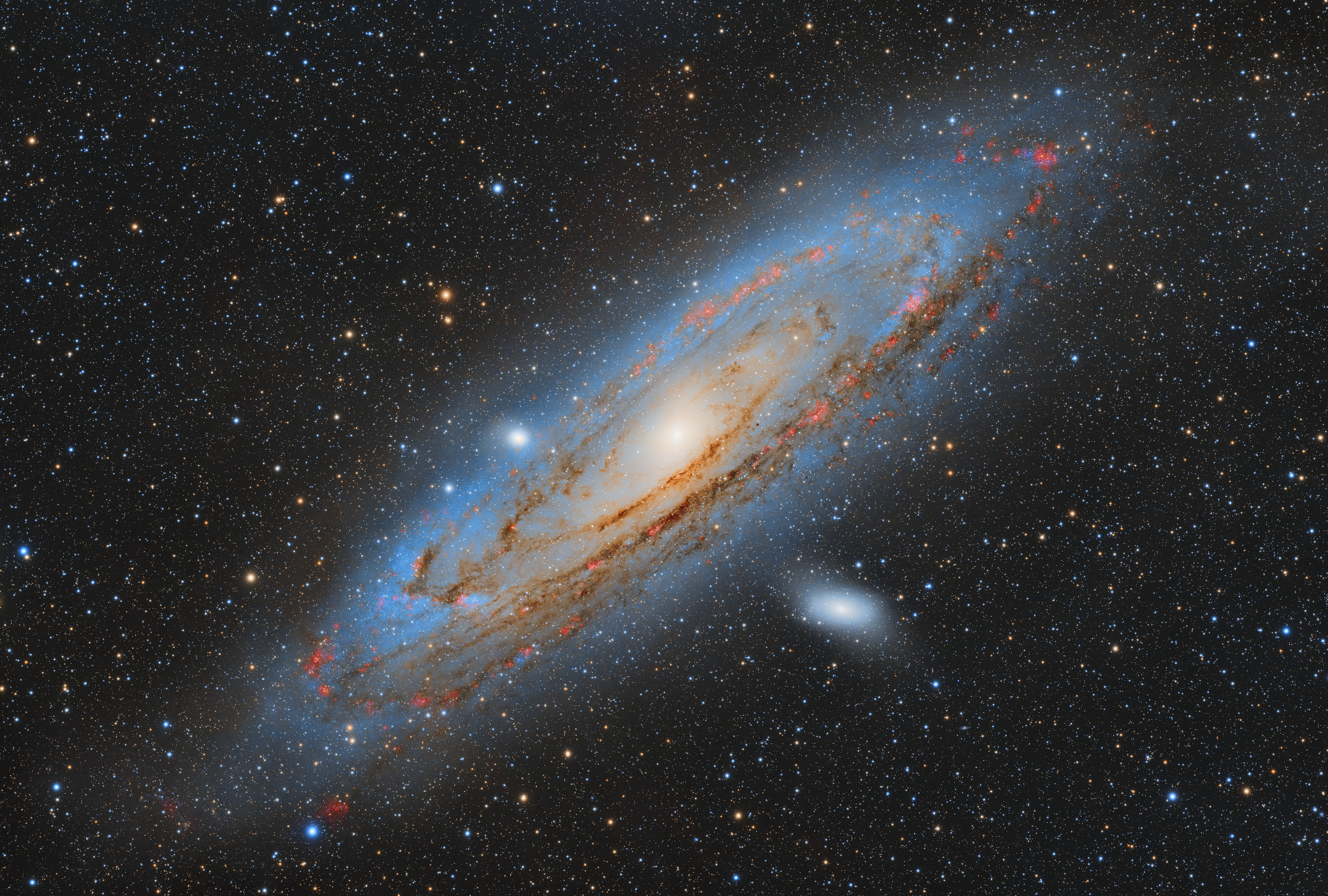
M31 – The Andromeda Galaxy
At a distance of approximately 2.5 million light-years, the Andromeda Galaxy (M31) is the nearest major galaxy to our own Milky Way and one of the dominant members of the Local Group. Spanning roughly 120,000 light-years across its bright stellar disk, it contains hundreds of billions of stars and is massive enough to be seen with the unaided eye under a sufficiently dark sky.
Because we view Andromeda at a steep inclination, much of its structure appears compressed into the familiar elongated shape seen from Earth. Yet deep imaging reveals considerably more. Sweeping dark lanes of interstellar dust cross the disk, separating populations of older yellow stars toward the central bulge from the younger, bluer stellar populations that become increasingly prominent throughout the spiral arms.
For this image, I combined three nights of LRGB and 5nm Hα data. The hydrogen data reveals a remarkable population of star-forming regions scattered throughout Andromeda's disk. These glowing red structures are clouds of ionized hydrogen surrounding young, energetic stars, tracing portions of the galaxy's spiral structure from the inner dust lanes far into its faint outer regions.
One of the most striking features is how far this activity extends. The Hα regions are not confined to the bright central portion of M31; chains of emission nebulae continue along the outer arms, where the stellar disk itself becomes increasingly faint. Each small red patch in the image represents a vast stellar nursery inside another galaxy, photographed across a distance of 2.5 million light-years.
Two of Andromeda's satellite galaxies are also visible in the field. M32 appears as the compact companion close to M31, while the more diffuse M110 lies farther from the main disk. Both are gravitationally associated with Andromeda and form part of the complex family of smaller galaxies surrounding it.
The Hα exposure also contained indications of extremely faint hydrogen emission across the wider field around M31. This signal was too weak in the available integration to separate convincingly from background noise, so I deliberately chose not to emphasize it in the final processing. Instead, the Hα data was used where it was strongest and most reliable: revealing the extensive network of star-forming regions within Andromeda itself.
The result is not simply a portrait of our nearest large galactic neighbor, but a glimpse into its ongoing evolution. Behind the immense population of old stars and prominent dust lanes, new generations of stars continue to form throughout Andromeda's spiral disk. Their hydrogen clouds glowing faintly across the 2.5-million-year journey their light has taken to reach us.
-------------------------------------------------
Technical Info:
Optics : Takahashi FSQ106-EDX4 @ F3.6 @ 380 mm (RD645)
Camera : Moravian G3-61000 Pro
Filters : Chroma Unmounted - LRGBHa Filter Set - 50 mm
Mount : NYX 101 - Harmonic Gear Mount
Guiding: Moravian C3-OAG + SX Lodestar X2
Acquisition : Voyager 2.3.14
Exposure : L (1x1) - 90 x 180 4 Hours 30 Minutes
R (1x1) - 40 x 180 2 Hours
G (1x1) - 40 x 180 2 Hours
B (1x1) - 40 x 180 2 Hours
Gain - 0
Hα (1x1) - 57 x 300 4 Hours 45 Minutes
Gain - 2750
Total Exposure: 15 Hours 15 Minutes
Processing : PixInsight 1.9.4 Lockhart (1695)
Date: 10.07.2026 - 14.08.2026 - 11.09.2026 - SQM ~ 21.20